Essey
Tief im stillen Wald - Die Kunst von Yasunari Kozuka
Ulrich Klieber Professor and Former Rector, Burg Giebichenstein University of Art and Design Halle
Von 2016 bis 2017 hat Yasunari Kozuka an der Burg Giebichenstein, Hochschule für Kunst und Design in Halle studiert. Dort haben wir uns kennengelernt. Die Kunsthochschule in Halle und die Nähe zum Bauhaus haben ihn sicher geprägt. Dessau liegt weniger als 50 km von Halle entfernt. Beide Schulen wurden fast zeitgleich gegründet. Yasunari Kozuka ist ein leidenschaftlicher Lehrer und Künstler. Beides. Wie viele Bauhauslehrer vor ihm auch…. Wassily Kandinsky, Paul Klee, Laszlo Moholy-Nagsy
2025 stellte Yasunari Kozuka im Contemporary Art Gallery in Nagoya in einer eindrucksvollen Einzelausstellung aus. Zwei Bildsequenzen standen dort im Mittelpunkt: „Deep forest“ und „Blumenstrauß“. Er bedient sich eines photografischen Verfahrens, der Cyanotypie, das die Herstellung von stabilen fotografischen Bildern erlaubt.Yasunari Kozuka verwendet van Dyke Braun für seine Ausdrucke. Er überträgt die Fotos auf hauchdünnes Gampi Papier.
Gampi heißt wörtlich übersetzt „Papierbaum“.Diese Pflanzenart kommt nur auf den westlichen japanischen Inseln vor.Die Fasern werden zum Herstellen von Japanpapier verwendet (wikipedia).
„Deep Forest“.
Die Waldbilder hat Yasunari Kozuka alle in Deutschland fotografiert. Er besucht auch heute noch regelmäßig Deutschland. „I truly understand my Japanese Identity“ hat er einmal gesagt. Diese japanische Identität ist überall zu spüren. Auch wie er den Wald sieht: Die Laubbäume sind im Winter fotografiert. Ohne Laub! Dünne grafische feinnervige Äste und Zweige kennzeichnen die Arbeiten. Wie grafische Kürzel, die auch eine gewisse Nähe zu japanischen Schriftzeichen vorweisen.
Ein Künstler sieht immer nur das, was er sehen will. Das hat auch mit Prägung zu tun. Wir sehen nicht den düsteren, dunklen , gefährchen Wald, wie wir ihn aus der deutschen Romantik her kennen. Yasunari Kozuka wählt bewußt aus : er entscheidet sich gegen die dunklen Tannen- und Fichtenwälder. Er liebt das Feingliedrige. Die Präsentation im Compemporay Art Gallery ist schnörkellos. Nichts Verspieltes. Kein Dekor. Sachlich. Kühl ! Reduziert auf das Notwendige.
Die Japanische Kunst und das Bauhaus haben viele Gemeinsamkeiten. „JAPONISMUS“ eine Faszination für Japan und seine Kultur hat das späte 19. Jahrhundert geprägt. Nicht nur van Gogh war ein Bewunderer der japanischen Kunst und Kultur. Auch Johannes Itten, Meister am Bauhaus bis 1923, hatte vieles..Philosophie und Kunst…, in seine Lehre übernommen. Und umgekehrt. „Die japanische Moderne erhielt durch das Bauhaus wichtige Impulse“ Ute Maasberg. Von 1930 bis 1932 studierten unter anderen Iwao und Michio Yamawaki am Bauhaus in Dessau. Er bei Mies van der Rohe. Sie in der Weberei bei Gunda Stölzl und Anni Albers.
Die Präsentation der „Deep forest“- Blätter geschieht in gleich großen Papieren. Sie werden aufgereiht und hintereinander geschichtet. So als wären es Kalenderblätter aus einem Abreißkalender. Tag für Tag. Monat für Monat. Jahr für Jahr. Die einzelnen Abbildungen kann man nicht erkennen. Durchgängig bei Yasunari Kozuka: Die Natur und die Naturgewalten……Rauch, Regen, Schnee, Licht, Schatten…. Die einzelnen Blätter sehen aus wären sie diesen Naturgewalten ausgesetzt gewesen. Verwitterung ,verschlissen, wie gegerbt.. Aber sie strahlen auch Kostbarkeit aus.
„Blumenstrauß“ (fotografiert in Japan)
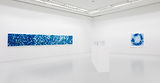
Wir sehen keinen Blumenstrauß, sondern einzelne gleich große aneinandergereihte Arbeiten. Eine große Patchwork arbeit, sehr ornamental .Nebeneinander,übereinander,dicht an dicht.
Die rote Rose steht auch für ein Symbol der Liebe. „Für mich soll’s rote Rosen regnen“ das sang Hildegard Knef 1968. Ein Lied, das immer noch sehr populär ist in Deutschland. Aber: bei Yasunari Kozuka sind die Rosen eisig blau. Kälte. Sie sind in Eis getaucht und erscheinen als Eisblumen an der Fensterscheibe. In einem Bild der Rosenserie sind einige der Rosen in dunkleres Blau getaucht. Ein großer dunkler Kreis entsteht. also doch ein Rosenstrauss ? Yasunaris Kozukas Kunst besticht durch ihre Vielschichtigkeit. Wir spüren die Verletzlichkeit der Natur, wir fürchten uns vor der Vergänglichkeit ,ein stilles memento mori.
Yasunari Kozuka beschwört und mahnt.
Er zeigt uns die Schönheit der Natur, er weckt eine Sehnsucht in uns
…….STILLE ! …….Stille ……Stille…. endlich Stille
Deep in the Silent Forest – The Art of Yasunari Kozuka
Ulrich Klieber Professor and Former Rector, Burg Giebichenstein University of Art and Design Halle
From 2016 to 2017, Yasunari Kozuka studied at the Burg Giebichenstein University of Art and Design in Halle, Germany. It was there that we first met. The art academy in Halle, together with its close proximity to the Bauhaus, clearly left a lasting impression on him. Dessau, where the Bauhaus was founded, lies less than 50 kilometers from Halle; both institutions were established at almost the same time.
Yasunari Kozuka is both a dedicated teacher and an artist—much like many Bauhaus masters before him, such as Wassily Kandinsky, Paul Klee, and László Moholy-Nagy.
In 2024, Yasunari Kozuka presented a solo exhibition at the Contemporary Art Museum in Nagoya. Two photographic series formed the core of the exhibition: Deep Forest and Bouquet.
Kozuka works with the photographic process of cyanotype, which allows for the creation of stable photographic images. For his prints he uses Van Dyke Brown and transfers the photographs onto wafer-thin gampi paper. The word gampi literally translates as “paper tree.” This plant species grows exclusively on the western islands of the Japanese archipelago, and its fibers are traditionally used in the production of Japanese paper.
Deep Forest
All photographs in the Deep Forest series were taken in Germany. Kozuka continues to visit the country regularly. “I truly understand my Japanese identity,” he once remarked. This sense of Japanese identity is perceptible throughout the works, particularly in the way he perceives and depicts the forest.
The deciduous trees are photographed in winter, stripped of their foliage. Delicate, finely branched limbs and twigs dominate the compositions. They appear almost like graphic signs, bearing a subtle affinity to Japanese writing systems.
An artist always sees only what he wishes to see; this is inseparable from personal formation and cultural imprinting. Here, we do not encounter the dark, threatening forest familiar from German Romanticism. Kozuka makes a conscious decision against dense fir and spruce forests. Instead, he is drawn to what is fragile and finely structured. The presentation of the works at the Contemporary Art Museum is deliberately austere: nothing playful, no decoration. Objective. Cool. Reduced to what is essential.
Japanese art and the Bauhaus share numerous affinities. Japonism—the fascination with Japanese art and culture—shaped the late nineteenth century. Vincent van Gogh was not alone in his admiration. Johannes Itten, a Bauhaus master until 1923, integrated many aspects of Japanese philosophy and aesthetics into his teaching. The exchange was reciprocal. According to Dr. Ute Maasberg, “Japanese modernism received important impulses from the Bauhaus.” Between 1930 and 1932, Iwao and Michio Yamawaki studied at the Bauhaus in Dessau. He worked under Mies van der Rohe, while she studied in the weaving workshop with Gunta Stölzl and Anni Albers. They later returned to Japan, where Iwao developed a hybrid Japanese and Western design style, with architects such as Mies van der Rohe and Le Corbusier as his influences.
The Deep Forest works are presented on uniformly sized sheets of paper, arranged sequentially and layered behind one another—reminiscent of pages from a tear-off calendar. Day by day. Month by month. Year by year. The individual images dissolve into a continuous flow and are no longer distinguishable as single motifs.
Throughout Kozuka’s work, nature and the forces of nature—smoke, rain, snow, light, shadow—are ever-present. The individual sheets appear as though they themselves had been exposed to these forces: weathered, worn, almost tanned. Yet at the same time, they radiate a sense of preciousness.
Bouquet
(photographed in Japan)
Here, we do not see a traditional bouquet of flowers, but individual works of identical size, arranged sequentially. The result is a large, ornamental patchwork—placed side by side, layered, densely interwoven.
The red rose is universally recognized as a symbol of love. “For me, it should rain red roses,” sang Hildegard Knef in 1968—a song that remains widely known in Germany today.
In Yasunari Kozuka’s world, however, the roses appear ice-blue. Cold. Immersed in ice, they resemble frost flowers on a windowpane. In one image from the rose series, several roses are submerged in a darker blue, forming a large, dark circle—perhaps, after all, a bouquet?
Yasunari Kozuka’s art is marked by its layered complexity. We sense the vulnerability of nature and our own fear of transience—a quiet memento mori. Kozuka implores and cautions. He reveals the beauty of nature and awakens a longing within us.… SILENCE … silence … silence … finally silence.
Serious and Serial Works – On Yasunari Kozuka's Forest
Takashi Ishizaki
Curator, Aichi Prefectural Museum of Art
Visitors to Yasunari Kozuka's installation will likely be moved by its tranquil atmosphere. However, the space is not silent, but tranquil. As viewers approach, their movement generates a faint breeze that stirs the paper. e slight rustling sound that is created quickly fades away. e paper's sensitivity to even the slightest action invites viewers to consider how such sounds and breezes are also part of the installation. Kozuka's creative process involves several stages. First, he selects the subject to photograph. Recently, Kozuka has favored photographing plants, such as trees and roses. However, not just any plant will do. For trees, for instance, those growing in Germany during the winter align with his theme. His eye, honed from his beginnings as a painter, is perhaps most evident in this initial stage of subject selection. Kozuka, who values series work, reportedly photographs thousands of trees during a single eld trip. Naturally, not all of them are chosen. ey undergo rigorous screening on the monitor. e captured data is output as a negative and then exposed to sunlight with cyanotype-coated gampi paper to produce the photograph. Kozuka focuses on using extremely thin, translucent gampi paper, which allows adjacent images to erode each other. e artist then meticulously arranges the completed prints. For two-dimensional works, the prints are swapped repeatedly until the arrangement feels right from every angle. For installation works, Kozuka considers the order when arranging them with gaps between them. us, through the repetition of this mind-numbing work, Kozuka's creations are born, one step at a time. He builds each piece meticulously, without cutting corners. His works can only be created this way. is process, far removed from the concept of eciency, is inextricably linked to the fact that his works are conceived as a series. Because he repeatedly produces the same size print, meticulous work is demanded. In this sense, I am convinced that Kozuka's production is both serious and serial. When gampi paper is arranged at regular intervals, viewers do not examine each piece individually. Instead, they take in how the work occupies the space as a whole. However, if desired, one can examine each piece patiently, one by one. e whole is composed of a collection of items, each slightly dierent from the next. Part and whole. e Japanese paper is the material used. e sun-exposure process. ough somewhat abstract, Yasunari Kozuka undeniably creates a "new forest" within his work. When one realizes this, a quiet frisson is imparted to the viewer.